


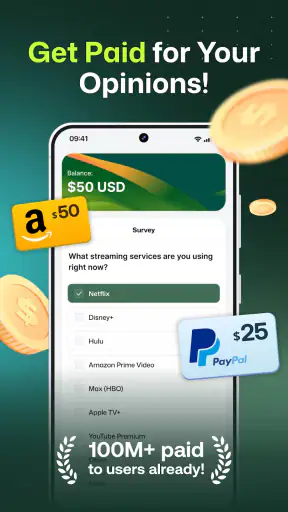

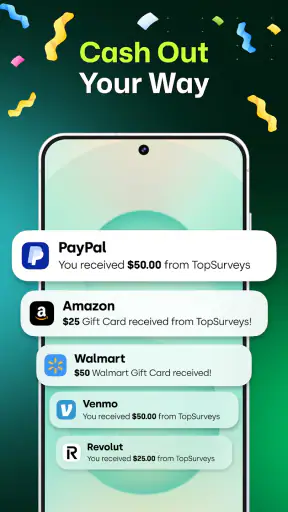
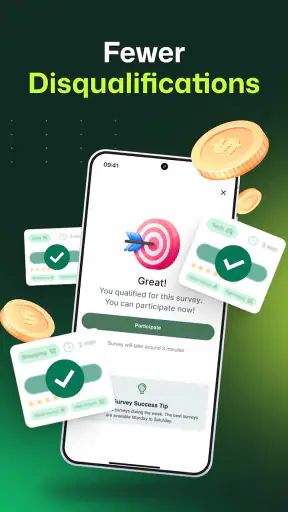
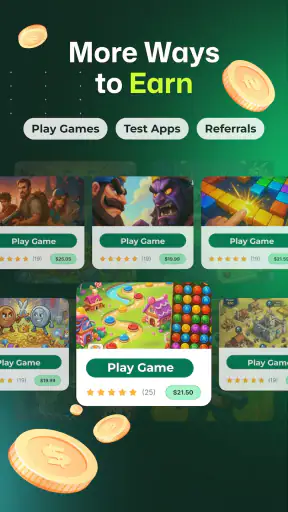
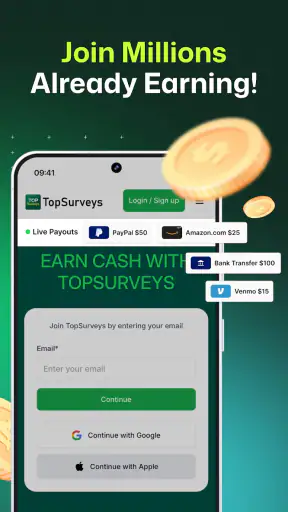
I tried TopSurveys as a lightweight way to turn spare minutes into small cash rewards, and my overall impression is straightforward: it is best understood as a survey app for occasional extra earnings, not as a dependable income source. The idea is simple, but deciding whether it deserves space on your phone depends on how patient you are with screening questions, changing survey availability, and rewards that build gradually rather than instantly.
TopSurveys is a free lifestyle app from Top Survey AB. It is available for devices running Android 9 or later, carries a Mature 17+ age rating, and its current version is 1.0.45. The app has reached over a million installs and holds a 4.5 average from around 388 thousand ratings, which suggests that many people find the basic experience worthwhile. I would still treat those numbers as a starting point rather than a guarantee, because survey apps can feel very different depending on your location, profile, and the kinds of studies available to you.
What I looked for before deciding whether it was worth using
My first decision criterion was not the headline promise of earning money. It was whether the app made the time trade-off clear. A survey can look attractive when it appears in a list, but the real value depends on how long it takes, whether I qualify after answering initial questions, and how consistently suitable surveys appear. That is the standard I used with TopSurveys.
The second criterion was convenience. I wanted something I could open during a short wait, complete without setting aside a full evening, and leave without losing track of what I had already done. TopSurveys fits that casual pattern better than a more involved side-income service. It feels designed for people who want to answer questions when they happen to have a few spare minutes.
The third criterion was expectation management. The app is free to download, but that does not mean every minute spent inside it has equal value. I recommend thinking of the rewards as a small bonus for sharing opinions rather than payment for a predictable number of hours. That distinction matters more here than any attractive earnings message.
I also considered whether the app suits different user types. Someone who enjoys giving feedback and does not mind occasional qualification checks may find it pleasant enough. Someone who needs reliable income, dislikes repetitive forms, or expects every survey invitation to lead to a completed task should probably compare other options before committing.
How the basic survey routine feels
The natural workflow is to check the available opportunities, read the apparent time commitment, answer the opening questions, and decide whether continuing feels worthwhile. I found that the most useful habit is to avoid treating every invitation as equally valuable. A short survey can make sense during a commute or while waiting for an appointment, while a longer one deserves more attention because interruptions become more frustrating.
That sounds obvious, but it changes how the app feels. If I open it expecting a steady stream of high-value tasks, the experience is disappointing. If I use it as a spare-minute activity and stop when the available choices no longer justify my time, it becomes much easier to live with.
One practical tip is to keep a personal sense of your time, rather than chasing every available questionnaire. I would note when a survey repeatedly asks several screening questions before ending, then become more selective with similar invitations. This protects your time and prevents the common mistake of judging the entire app by one frustrating attempt.
Another useful approach is to answer profile questions carefully and consistently. Survey matching depends on the information you provide, so rushed or contradictory answers can make the experience less relevant. I would set up the profile when I have enough time to read each question, then review answers if my circumstances change. That is more effective than trying to rush through setup just to reach the survey list.
Where TopSurveys works particularly well
The strongest part of TopSurveys is its low barrier to entry. Since the app is free, I can test the routine without paying upfront. That makes it easier to decide whether completing opinion surveys fits my habits. I do not need to turn it into a major project; I can simply use it when I would otherwise be scrolling through unrelated content.
It also suits people who prefer a focused purpose. Instead of giving me a broad collection of unrelated tasks, the app centers the experience on answering surveys and earning rewards. For a user who specifically wants to share opinions online, that narrower focus can feel less distracting than a general rewards platform filled with shopping offers, games, promotions, and unrelated activities.
The app is also a reasonable match for a realistic everyday situation: imagine waiting for a delayed train with ten or fifteen minutes to spare. I could open TopSurveys, check whether a suitable questionnaire is available, and complete it if the time estimate feels sensible. If nothing fits, I can close the app without having invested much. That flexibility is more important than it may appear, because survey work is easiest to tolerate when it stays optional.
A less obvious strength is that the app can help users become more disciplined about small digital activities. I would set a limit before opening it, such as checking once during a lunch break rather than repeatedly refreshing throughout the day. This prevents the reward hunt from taking over the time it is supposed to fill.
TopSurveys may also appeal to someone who values privacy boundaries in a practical way, even though I would still read the app’s current terms and permission requests before using it extensively. The key point is to share only what you are comfortable sharing and to remember that survey participation is an exchange: your opinions and profile information are part of the value you provide.
The trade-offs that are easy to overlook
The biggest limitation is that survey availability and suitability are not fully under your control. A survey may appear relevant but still screen you out after a few questions. That is not necessarily a defect unique to this app; it is a basic feature of market research. Still, it affects the real value of your time, so I would not assume that an invitation equals a guaranteed completion.
Another friction point is repetition. Even when the topics change, the structure of answering demographic or preference questions can start to feel similar. If you enjoy giving opinions, that repetition may be harmless. If you want varied tasks, TopSurveys can become dull faster than a broader rewards app.
There is also a psychological trade-off. Seeing a reward balance increase can encourage frequent checking, but the balance itself is not the same as money in your everyday budget. I would decide in advance how often to use the app and avoid counting expected rewards before they are actually available to redeem. That simple rule keeps the experience recreational rather than financially stressful.
The app includes in-app purchases priced at $9.99 per item. Because the core download is free, I would pay close attention to any purchase prompt and avoid assuming that spending money is necessary to participate. A survey app should be evaluated on the value of its free workflow first. If a purchase appears to promise faster progress or another advantage, I would compare that cost with the modest, variable nature of survey rewards before accepting it.
The Mature 17+ rating is another reason I would not treat this as an app for younger users. Parents and guardians should consider the age classification before allowing access, and adults should still use ordinary caution when entering personal details into any service that asks about opinions, habits, or demographics.
How it compares with the usual alternatives
The closest alternatives fall into several categories, and each category changes the decision. Dedicated survey apps like TopSurveys are the most direct choice when the only activity you want is answering questionnaires. Their advantage is focus. Their weakness is that you have fewer ways to stay productive when suitable surveys are unavailable.
General rewards platforms offer a wider mix, often combining surveys with shopping activities, promotional tasks, or other offers. I would choose that category if variety matters more than a clean survey-only routine. The trade-off is a busier experience, with more conditions to read and more opportunities to spend time on tasks that do not interest me.
Cashback services are better for someone who already shops online and wants rewards attached to purchases they were planning to make anyway. They are not a direct replacement for TopSurveys because their value depends on shopping behavior rather than opinions. If I rarely shop through a rewards service, a survey app may be easier to use consistently. If I make regular eligible purchases, cashback could be more efficient because it fits into an existing activity.
Freelance marketplaces are a different proposition again. They can offer more meaningful earning potential, but they require skills, proposals, deadlines, and a willingness to compete for work. I would not switch from TopSurveys to freelancing merely because the survey rewards feel small; I would switch only if I wanted to invest serious effort in a skill-based side income.
Paid research communities may suit users who want fewer, more involved studies. Those opportunities can require more patience and may not appear as casually as a short survey app. TopSurveys is the better fit when convenience is the priority and I want something I can check without planning my week around it.
What switching really costs
Moving to another survey or rewards app is easy in the technical sense, but the practical cost is the time spent building another profile and learning another reward system. I would not abandon TopSurveys after one poor survey. Instead, I would test it across several short sessions and judge whether the available opportunities match my schedule.
If I did switch, I would avoid installing a large cluster of similar apps immediately. That can create notification clutter, repeated screening questions, and a temptation to chase tiny balances across multiple services. A better method is to compare one alternative at a time using the same personal rule: how much attention does it require, how often does it offer a suitable task, and does the experience remain tolerable after the novelty fades?
There is a useful middle path as well. I could keep TopSurveys as a secondary option while using a cashback service for planned shopping or a freelance platform for serious work. This is more sensible than demanding that one app handle every kind of earning. TopSurveys works best in a small role, and forcing it to become a primary income tool is where disappointment begins.
I would also keep my account information organized. Since survey profiles can influence which questionnaires appear, repeatedly creating new accounts may make the experience less consistent and can complicate reward tracking. My preference would be to use one account carefully, record any important redemption details, and review the app’s current instructions before making changes.
Who should try it, and who should skip it
I would recommend TopSurveys to adults who want a free, simple way to use occasional downtime, enjoy answering questions, and understand that rewards will vary. It is especially suitable for someone who prefers a focused survey experience over a crowded rewards marketplace.
I would be more cautious recommending it to anyone with a strict hourly earnings target. The app cannot replace a job, contract work, or a dependable freelance arrangement. It is also a poor match for people who become annoyed by screening questions, dislike sharing opinions about consumer habits, or need immediate access to a predictable amount of money.
Users on older devices should check compatibility before planning around it, since the app requires Android 9 or later. I would also consider the age rating seriously rather than treating it as a minor label. Adults who are comfortable with the subject matter and information exchange can make their own decision, while younger users should not be brought in casually.
The developer, Top Survey AB, has built an app with a clear everyday purpose, and the strong average rating indicates broad user satisfaction. Even so, ratings cannot tell me whether the available surveys will match my own profile. I would use the free entry point to test that personally instead of relying only on popularity.
My recommendation after weighing the alternatives
My recommendation is to try TopSurveys if you want a low-commitment survey app and can treat the rewards as occasional extras. Give it a fair test during the kinds of spare moments when you would normally do nothing productive, then judge it by the time-to-reward trade-off rather than by the most optimistic possibility.
I would keep notifications limited if the app allows that choice, check it at planned times, and stop when the available survey no longer feels worth the attention. I would also avoid in-app purchases until the free experience has clearly proved useful; paying $9.99 for an item does not automatically make variable survey work more profitable.
For me, the app’s best quality is its simplicity. It gives opinion-focused users a direct place to look for small reward opportunities without requiring the broader ecosystem of a shopping or freelance platform. Its main weakness is the same thing: when suitable surveys are scarce or screening takes too long, there is little else to do inside it.
In the end, I see TopSurveys as a sensible optional tool, not a financial solution. If your goal is to fill short gaps in the day with surveys and you are comfortable with uneven results, it is worth testing because the download is free. If your goal is reliable income, richer task variety, or better returns for specialized work, I would choose a different category and leave this app in the supporting role it handles best.


